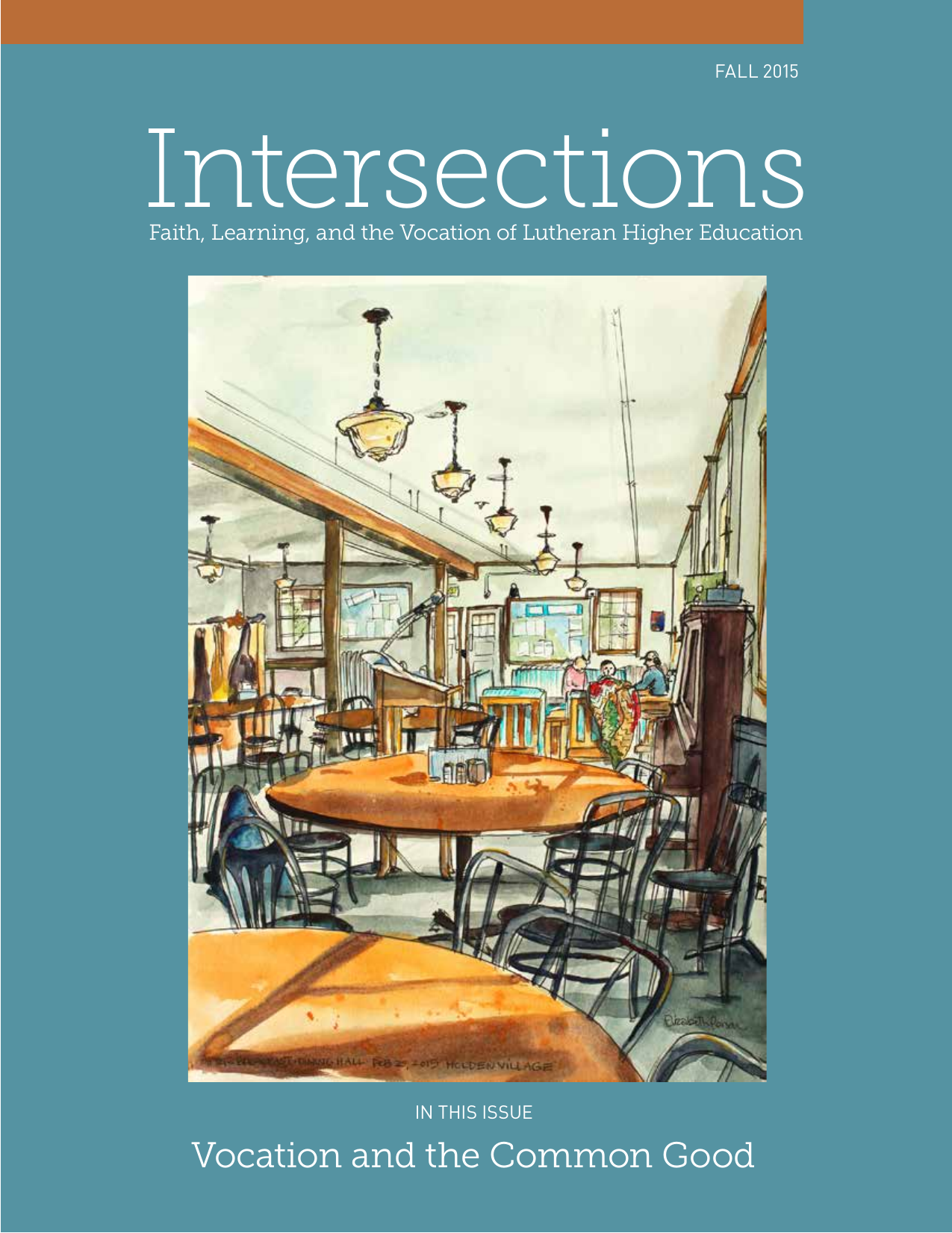
Vocation and the Common Good
The Fall 2015 “Vocation and the Common Good” issue draws on the 2015 Vocation of a Lutheran College Conference at Augsburg, asking what is left of “the commons” in an age of privatization. Essays move from the Lutheran sense of a common walk of life and “little bits of good,” through Luther’s “greed is an unbelieving scoundrel” and interfaith cooperation, to a critique of the attentional commons in a wired classroom, a presidential call to “say something theological,” and a study of how women college presidents experience their calling.
Editors
Articles in this Issue
-
 Editorial
From the Editor
Jason A. Mahn
Mahn introduces the “Vocation and the Common Good” issue by asking what is left of “the commons” in an age of privatized goods and education-as-commodity, and frames church-related colleges — with their stubborn vocabulary of “liberal arts,” “collegiate,” and “calling” — as among the least fully-privatized resources left in American life.
-
Article
Vocation and the Common Good
Mark Wilhelm
Wilhelm argues that ELCA colleges and universities are Lutheran not by ethnic culture or institutional checklists but because they stand in a 500-year-old intellectual tradition that educates for vocation. He draws out two insights from that tradition — a common walk of life shared across callings, and a humility about claims to know the good — to ground the schools’ commitment to prepare students for the common good.
-
Article
Making the Common Good Common
René Johnson
Johnson reflects on the Servant Leadership House for women at Finlandia University — from a sweaty trip to the local landfill to weekly habits of campus presence — to argue that the common good becomes truly common when it is embedded in the ordinary details of vocational living, and that Luther’s sense of neighbor calls servant leaders to “little bits of good” as well as to more radical pursuits of justice.
-
Article
"Greed is an Unbelieving Scoundrel": The Common Good as Commitment to Social Justice
Samuel Torvend
Torvend uses his Lutheran Heritage course at Pacific Lutheran University to ask what “the common good” might mean concretely — fresh air, clean water, food, shelter, healthcare — and traces the early Lutheran reform of literacy and social welfare to argue that the first gift of Lutheran education is the capacity to question the status quo and to push beyond charity into the pursuit of social justice.
-
Article
Grinding for the Common Good and Getting Roasted
Rahuldeep Singh Gill
Reading Starbucks’ ill-fated “Race Together” campaign as a parable for campus work on the common good, Gill argues that interfaith cooperation, vocational reflection, and the “re-storying” of our campuses require us to err boldly across lines of difference — not pretending that difference doesn’t matter, but inviting students to imagine and realize what the common good might mean to them.
-
Article
Attentional Commons and the Common Good: Technology and Higher Education
Amy Weldon
Weldon argues that the electronic devices our students (and we) reach for are designed to monetize attention and fragment the very capacities — tolerance for complexity, sustained focus, real conversation — that build lives of meaning and service to the common good. Drawing on Crawford, Lanier, Arendt, and Palmer, she sketches practical tech-mindfulness for the small-college classroom as a defense of the “attentional commons.”
-
Article
Say Something Theological: A Meditation on the Vocation of Lutheran Colleges and Universities to Serve the Common Good
Paul C. Pribbenow
Pribbenow expands Luther’s “priesthood of all believers” into a meditation on doing theology with the Bible in one hand and the New York Times in the other — reading Luke 14 alongside walls, immigration, and hunger in his Minneapolis neighborhood — and argues that the leadership of Lutheran colleges demands a willingness to engage the theological issues at the heart of their public vocation.
-
Article
Women Presidents in Higher Education: How They Experience Their Calling
Aimee Goldschmidt, Gary McLean, Katherine A. Tunheim
Drawing on in-depth interviews with fifteen women college presidents and a transformative-learning-theory framework, Tunheim, McLean, and Goldschmidt trace a three-stage journey — identifying, interpreting, and pursuing the call — and ask what the language of vocation contributes to the preparation and mentoring of women leaders in higher education.